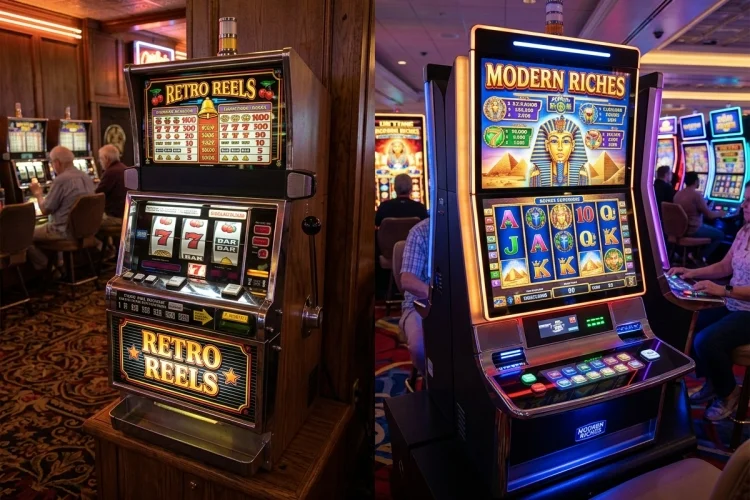
A three-reel slot can display a result almost instantly: the reels stop, the symbols line up, and the outcome is easy to read.
A five-reel game can turn the same basic spin into something much more elaborate, with wilds, scatters, collect symbols, respins, or free-spin rounds.
The Three-Reel Slots vs Five-Reel Slots comparison therefore involves more than counting columns on a screen.
Each structure gives game designers different possibilities, but neither format automatically offers higher RTP, more frequent wins, or a mathematical advantage for players.
Three-Reel Slots Come From the Classic Format
The three-reel structure is strongly associated with early mechanical slot machines.
Traditional designs focused on simple combinations such as matching fruits, bells, sevens, and BAR symbols across a central payline.
Modern digital versions preserve much of that visual identity.
BetMGM describes three reels, limited paylines, classic symbols, and relatively straightforward features as common characteristics of classic slots.
However, digital technology allows developers to expand the formula.
Reel Liberty 7s Classic, for example, uses three reels and nine fixed paylines while incorporating a bonus wheel and multipliers.
So the modern three-reel category includes both minimal games and more feature-rich interpretations.
Five-Reel Slots Became the Video-Slot Standard
Five reels provide more space for game designers.
A common five-reel slot uses three symbol rows, creating a 5×3 grid.
That format can accommodate many traditional paylines while leaving room for special symbols.
Modern developers also experiment beyond the standard layout.
Pragmatic Play’s Heartbreakers uses five reels and four rows with multiple collect symbols and a respin bonus mechanic.
Five-reel games can therefore support much more visual information on each spin.
That flexibility has made them a natural platform for modern slot mechanics involving multipliers, free spins, expanding symbols, and persistent bonus elements.
Reel Count Does Not Equal Payline Count
This is one of the most important distinctions for beginners.
Three reels do not necessarily mean three paylines.
Five reels do not necessarily mean five paylines.
For example, Super Tiki Strike is a 3×3 game with five paylines.
Meanwhile, a five-reel title can have five paylines, 20 paylines, hundreds of ways, or another system entirely.
BetMGM’s 3 Mystic Lamps uses five reels but advertises 243 ways to win rather than a simple traditional line structure.
Therefore, paylines and reels describe seperate parts of a slot.
Reels describe the vertical columns.
Paylines or winning ways describe how symbols can combine to generate payouts.
Three-Reel Games Often Have Faster Visual Feedback
With a smaller grid, there is less information to evaluate after every spin.
Imagine a simple game where three matching symbols across one line create the main payout.
When the reels stop, the result is almost immediately obvious.
That can make three-reel games appealing to players who prefer a minimal interface.
Classic graphics can also create a sense of nostalgia.
Seven symbols, fruits, bells, and BAR icons are easy to recognize even for someone who has not played many modern slots.
The trade-off is that a deliberately traditional title may have fewer bonus sequences.
There may be no multi-stage free-spin feature or complex collection meter.
For some players, that simplicity is exactly the attraction.
Five-Reel Games Can Offer More Layered Features
A five-reel grid gives developers more positions where special symbols can land.
That makes mechanics such as wild reels, stacked symbols, scatter triggers, collections, and hold-and-spin bonuses easier to integrate.
Take 3 Mystic Lamps as an example.
Its five-reel layout uses 243 winning ways and a Hold and Spin feature built around differently colored Gem symbols. Each can introduce effects such as multipliers or extra spins.
Heartbreakers uses another five-reel structure with collect symbols and multipliers associated with individual reels.
These examples show why modern five-reel games can feel less predictable visually.
Several systems may operate simultaneously even though the basic random spin remains simple underneath.
Which Format Has More Winning Combinations?
Five-reel slots often can provide more combinations because the larger grid supports more positions and potential winning paths.
But “more ways to win” should not be interpreted as “better mathematical odds.”
Suppose one game offers five paylines and another offers 243 ways.
The second clearly evaluates more symbol combinations.
However, its symbol probabilities and payout values are designed around that larger number of possibilities.
Game mathematics balance how often combinations appear against how much they pay.
A game with fewer paylines can offer larger rewards for some rare combinations, while another game may generate more frequent smaller hits.
Without knowing the paytable and probability model, the number of winning ways alone tells us very little about overall expected return.
What About RTP?
Return to Player is calculated from the game’s complete mathematical model.
It is not determined by whether the game has three or five reels.
Triple Diamond, a three-reel title presented by BetMGM, lists a 95.06% RTP for the cited version, while other three- and five-reel games can publish entirely diffrent values. BetMGM also notes that RTP can vary across jurisdictions.
This makes direct game-by-game comparison important.
If Game A has three reels and Game B has five, the grid alone provides no reliable basis for deciding which has the higher theoretical return.
Open the information menu and check the specific RTP provided for the version available to you.
Remember that RTP is a long-run theoretical percentage, not a prediction of one session.
Volatility Is Independent of Reel Count
A common assumption is that simple classic slots are low volatility while complex video slots are automatically high volatility.
Real games do not follow that rule consistently.
Volatility depends on how a game’s theoretical payouts are distributed.
A three-reel title with a large jackpot and uncommon winning combinations could produce significant variance.
A five-reel game designed around frequent small wins might feel smoother.
Maximum payout also does not tell the entire story.
A game advertising a 10,000x maximum win does not necessarily hit that amount frequently, and a smaller maximum does not guarantee constant wins.
Players should check any published volatility indicator separately from reel count, RTP, or maximum payout.
Bonus Features Change the Experience More Than Reel Count
Consider two hypothetical five-reel games.
The first has ten simple paylines and no free-spin feature.
The second has wilds, scatter-triggered free spins, increasing multipliers, and respins.
Both have five reels, but they can feel completely different.
The same applies to three-reel games.
Super Tiki Strike uses a classic 3×3 layout but includes money symbols, collect mechanics, multipliers, and a respin bonus game.
BetMGM’s Crystal Reels likewise combines a three-reel layout with wild multipliers, jackpots, and a Cash on Reels feature.
Therefore, the number of reels is only the starting point.
Feature design often has a much bigger influence on the overall gameplay experiance.
Which Format Is Easier for Beginners?
A straightforward three-reel game is usually easier to read.
There may be fewer lines, fewer symbols, and fewer bonus rules to remember.
However, an uncomplicated five-reel game can also be beginner-friendly.
The better question is how complicated the paytable is.
Before playing, look at:
How winning symbols connect.
Whether paylines are fixed.
What wild and scatter symbols do.
How bonus rounds trigger.
Whether the stake covers all active ways.
These details matter more than counting reels alone.
If the paytable requires several minutes just to understand the base game, the experience will naturally feel more complex regardless of the reel count.
Three Reels Can Still Feel Modern
Three-reel formats have not disappeared just because five-reel video slots became widespread.
Developers frequently combine classic layouts with current mechanics.
Pragmatic Play’s Aztec Gems uses a compact 3×3 core grid together with a fourth multiplier reel that can boost qualifying wins.
Super Tiki Strike combines its 3×3 layout with collect symbols and respins.
These games show how developers can preserve the readability of classic reel structures while adding modern features.
The distinction between “classic” and “modern” is therefore becoming less absolute.
A three-reel title may look retro while operating with thoroughly modern digital mathematics underneath.
Five Reels Do Not Automatically Mean Better Gameplay
More symbols and features can create variety, but complexity is not inherently better.
Some players enjoy watching several bonus systems interact.
Others prefer a game where the reels stop and the result can be understood instantly.
Neither preference changes the underlying randomness.
A feature-heavy five-reel slot does not require more player skill, and a traditional three-reel game is not automatically easier to win.
Slot outcomes are determined by the game’s random system and mathematical configuration.
The useful comparision is therefore about experience rather than strategy.
Choose a layout because you understand and enjoy its rules – not because the reel count supposedly predicts future results.
Three-Reel Slots vs Five-Reel Slots comes down mainly to presentation, complexity, and feature design.
Three-reel games often deliver simpler, classic-style play, while five-reel layouts give developers more room for paylines, winning ways, and layered bonuses.
Neither format guarantees higher RTP or better odds. Compare individual paytables, volatility, RTP, and feature rules, then choose the structure that is easiest for you to understand.