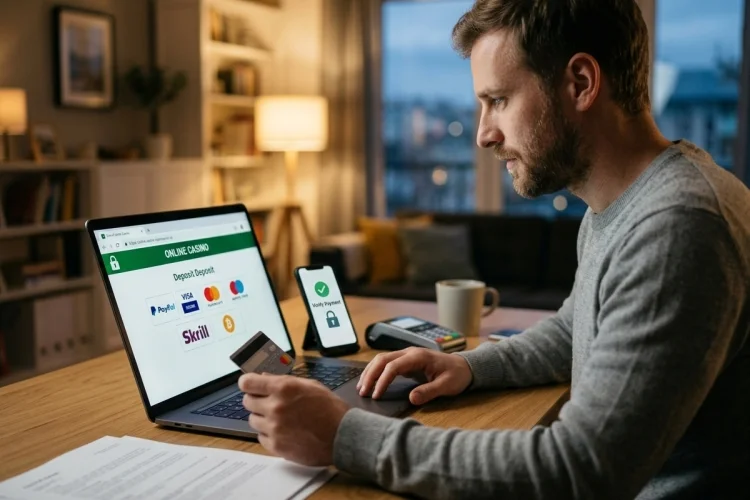
A fast casino payment is useful, but speed is not the same as security. Cards, e-wallets, bank transfers, and mobile payment services all move money differently and expose different types of information along the way.
Finding a Secure Casino Payment Method requires understanding those differences rather than simply picking whichever button appears first in the cashier.
Strong authentication, encrypted checkout, tokenization, account notifications, and controlled access to financial credentials can all reduce payment risk.
The best practical choice depends on both the payment technology and the security practices surrounding your account.
What Makes a Casino Payment Method Secure?
Payment security is not created by one feature.
A strong system generally combines encrypted communication, secure handling of financial data, customer authentication, transaction monitoring, and controls that reduce the value of stolen information.
PCI DSS provides baseline security requirements for businesses and services involved in payment-card processing.
For online cards, EMV 3DS can add another authentication layer.
Tokenization can also replace valuable payment credentials with less useful substitute values.
These protections address different risks, which is why layered security matters.
A payment method offering several of these controls is generally more robust than one depending on a single password or static card number.
How Secure Are Card Payments?
Card payments remain common because they are convenient and widely accepted.
Modern online card payments can include several security layers.
EMV 3-D Secure helps card issuers authenticate online customers using transaction, device, and payment information. When additional assurance is required, the issuer can request a challenge before approving the payment.
That challenge could involve an app notification, biometric confirmation, or another verification method.
Cards can also benefit from tokenization.
Visa says tokens can replace sensitive payment credentials with unique digital values, while Mastercard similarly uses payment tokens to strengthen transaction security.
For players, the practical question is not simply “Are cards safe?” but “How securely does this particular checkout handle my card?”
How E-Wallets Change Data Exposure
E-wallets can provide an additional layer between a player’s casino account and primary funding source.
Suppose your wallet already contains a linked card.
When a compatible casino accepts the wallet, the casino may not need to directly collect the same card information it would require during a traditional manual card payment.
That can reduce how widely payment credentials are distributed.
The trade-off is concentration.
If the wallet controls several cards or balances, compromising that wallet account can become particularly serious.
This makes strong authentication essential.
Use a unique password and activate multi-factor authentication whenever the provider supports it.
NIST notes that MFA creates another barrier after password compromise, while also warning that manually entered OTP and SMS methods are not fully phishing-resistant.
Are Bank Transfers Secure for Casino Payments?
Bank transfers move funds through banking systems rather than traditional card-processing rails.
They can reduce the need to give a casino card credentials.
Depending on the system, the player may authenticate directly through their bank or banking app.
That separation can be useful, but it does not eliminate risk.
A transfer authorized to the wrong recipient can be difficult to reverse, especially when the user personally approved it.
Players should carefully verify the payee, amount, and transaction reference before confirming anything.
Avoid transferring funds using account details received through unexpected emails or chat messages.
Instead, use the banking instructions shown inside the casino’s authenticated cashier area and verify unusual requests independently.
Why Tokenization Is Valuable
Traditional card numbers are sensitive because they can potentially be reused if stolen.
Tokenization changes that equation.
Visa describes tokenization as replacing the primary account number with a digital token that conceals the underlying payment details.
Mastercard similarly describes tokens as a way to protect sensitive payment credentials during digital transactions.
Imagine two databases are compromised.
Database A contains reusable card numbers.
Database B contains tokens that are limited to a particular payment environment.
The second dataset can be much less useful to an attacker.
Visa reported in 2026 that, across its cited global card-not-present data, tokenized credentials had a lower fraud rate than non-tokenized credentials, although individual merchant results can vary.
This is why tokenization has become a major part of modern digital-payment security.
Authentication Should Protect More Than Login
A strong payment system should not rely entirely on the casino account password.
Your bank or payment provider may perform its own authentication before authorizing a transaction.
EMV 3DS enables issuers to use risk information and request additional verification when necessary.
Modern payment authentication is also moving toward stronger cryptographic approaches.
EMVCo describes Secure Payment Confirmation as a technology that can use platform authenticators such as biometric-enabled device authentication and provide cryptographic evidence that the cardholder accepted specific transaction details.
The practical benefit is simple: payment approval becomes more closely tied to both the legitimate user and the specific transaction.
Whenever authentication appears, check the amount and merchant before approving it.
Watch Out for Phishing During Deposits
Attackers do not always need to defeat payment encryption.
Sometimes it is easier to convince the user to hand over the information voluntarily.
A phishing message might claim that a casino account needs urgent verification and provide a fake payment link.
The fake page could collect login information, card data, or temporary authentication codes.
NIST warns that passwords and manually entered one-time passcodes can be captured through phishing, while FIDO/WebAuthn-based cryptographic authentication offers stronger phishing resistance.
Before entering payment information, inspect the domain carefully.
Navigate to the casino manually rather than using questionable links.
A typo in a domain can be more dangerous than a typo in ordinary text.
Consider Payment Method Recovery and Disputes
Security also includes what happens after something goes wrong.
If your card is stolen, can it be frozen immediately?
If your wallet account is compromised, can you revoke active sessions?
If an unauthorized transaction occurs, what reporting procedures does the payment provider offer?
These questions are easy to overlook before a problem happens.
Open your banking or wallet application and become familiar with its securty controls. Look for card locking, device management, transaction notifications, authentication settings, and official fraud-reporting channels.
Keep transaction receipts as well.
Having the amount, date, merchant descriptor, and transaction reference can make it easier to investigate an unexpected charge.
Check Whether Deposits and Withdrawals Use the Same Method
A secure deposit method should also make sense for withdrawals.
Some casinos may return funds to the original payment source when possible, while others may require an alternative payout method.
That can create additional verification.
Before depositing, check whether the chosen method supports withdrawals, what identity checks may apply, and whether fees or currency conversion are involved.
For example, depositing through one wallet and later withdrawing through an unfamiliar bank-transfer provider can increase the number of companies handling personal or financial data.
A simpler payment route can sometimes be easier to moniter.
But simplicity should not replace security checks.
Avoid Saving Payment Details Without a Reason
Saving card information makes repeat payments convenient.
It also creates a persistent credential relationship with the merchant or payment provider.
Tokenization can reduce that risk because secure tokens can be stored instead of reusable primary card credentials. Visa notes that tokenized credentials can be managed for future digital payments without repeatedly exposing the underlying card information.
Still, players should consider whether saved payment access is necessary.
If you rarely use a particular casino, removing stored payment methods may reduce unnecessary long-term exposure.
The same principle applies to old e-wallet connections and unused banking permissions.
Review them periodically instead of allowing old financial links to accumulate indefinately.
Security Does Not Mean Gambling Is Financially Safe
A perfectly secured payment can still fund a gambling transaction.
Cybersecurity protects the transaction from certain technical risks; it does not change the mathematics of casino games or make gambling a reliable way to earn money.
Security also does not prove that the operator receiving the funds is legitimate.
Check casino licensing, withdrawal conditions, account-verification rules, and responsible gambling controls seperately.
Think of payment security as one part of a larger checklist.
A trusted bank, strong authentication, tokenization, and encrypted checkout can protect how money moves, but players still need to decide whether the destination itself is appropriate.
A Secure Casino Payment Method combines reliable payment infrastructure with strong authentication, careful data handling, and useful account controls.
Cards can benefit from 3-D Secure and tokenization, wallets can reduce direct credential exposure, and bank transfers can keep card data out of the transaction.
Compare the complete payment route, enable strong authentication, verify every payment request, and review withdrawal options before depositing.